Malawi is on the cusp of fully operationalising the National Single Window (NSW).
This flagship digital reform is designed to simplify cross-border trade and aligns with the President Peter Mutharika’s directive to accelerate digital transformation across key sectors of the economy.
For years, discussions on Malawi’s trade performance have focused primarily on increasing production, promoting value addition and expanding exports. Yet an equally important question has received comparatively little attention: How efficiently do these goods actually move across borders?
In today’s global economy, competitiveness is no longer determined solely by absolute advantage in production. It is largely shaped by the efficiency of trade facilitation systems. Time, in particular, has emerged as a key component of trade costs. Buyers are no longer just asking, “Can you produce?” They are asking, “Can you deliver quickly, reliably and at low cost?” Thus, every delay in Malawi’s trade facilitation procedures compounds the disadvantages inherent in being a land-linked economy.
This is why the rollout of the NSW in Malawi is such an important step toward unlocking the country’s trade potential. For years, traders have had to navigate a fragmented system, physically moving from one office to another and engaging with multiple government ministries, departments, and agencies (MDAs), often repeating documentation and enduring lengthy approval processes before goods can be exported or imported.
These inefficiencies translate into higher logistics costs and lost opportunities in time-sensitive export markets. They also increase administrative burdens for MDAs responsible for regulating trade. Recognising these challenges, many countries are investing in digital systems to streamline border procedures and improve coordination among agencies.
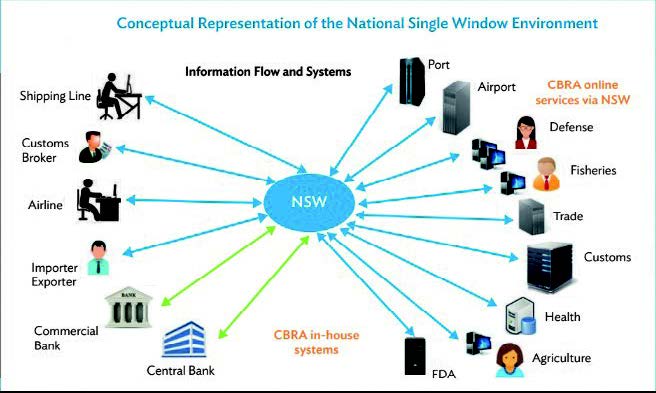
Similarly, the Government of Malawi, through the Ministry of Industrialisation, Business, Trade and Tourism, has developed a NSW system that allows traders to submit all documentation and information requirements for imports, exports and transit through a single digital entry point. This system replaces the traditional practice of visiting multiple government offices to obtain approvals.
For an economy such as Malawi, which is seeking to expand exports and attract investment, adopting such systems is an important step toward enhancing trade competitiveness.
Global shift toward digital trade systems
Globally, trade facilitation is now widely recognised as a key determinant of economic competitiveness. Governments are digitising trade procedures as part of efforts to improve efficiency. Licensing, customs clearance, payments, and other regulatory procedures are progressively moving from paper-based processes to integrated digital platforms designed to enhance service delivery, accountability and transparency.
This shift gained significant momentum following the conclusion of negotiations on the World Trade Organization’s (WTO) Trade Facilitation Agreement (TFA) at the 2013 Bali Ministerial Conference. The agreement entered into force on February 22 2017 and Malawi ratified it on July 12 2017. It introduced a comprehensive set of reforms aimed at expediting the movement, release and clearance of goods including those in transit while promoting stronger cooperation between customs administrations and other regulatory authorities involved in cross-border trade.
According to the WTO, empirical estimates suggest that full implementation of the agreement could reduce global trade costs by over 14 percent and generate substantial gains in trade volumes, particularly for developing and least developed countries.
Article 10.4 of the TFA explicitly encourages WTO member States to establish single window systems to enable traders to lodge documentation and receive approvals through a single-entry point. This reform agenda has also gained strong traction at the regional level, with institutions such as the African Continental Free Trade Area (AfCFTA), the Common Market for Eastern and Southern Africa (Comesa), and the Southern African Development Community (Sadc) of which Malawi is a member actively promoting the NSW as a key instrument for enhancing regional trade facilitation.
Evidence from Kenya also demonstrates the tangible impact of NSW systems and offers lessons for Malawi’s rollout. Managed by the Kenya Trade Network Agency, the system links around 35 government agencies and more than 10 000 users, reportedly cutting procedures by nearly 50 percent, documentation by 30–50 percent and processing times by more than half. The platform has also improved compliance and increased revenue collection across participating agencies.
However, Kenya’s experience also highlights critical implementation challenges, including system downtime, early resistance from some government agencies, and limited institutional coordination. These are important lessons for Malawi as it rolls out its own NSW.
State of implementation in malawi
Encouragingly, Malawi has also made tangible progress in establishing its NSW system. Records from the Ministry of Industrialisation, Business, Trade and Tourism indicates that phase one successfully onboarded several key institutions, including the ministry itself, the Department of Animal Health and Livestock Development, the Department of Agricultural Research Services, the Cotton Council of Malawi, the Department of Fisheries, the Malawi Bureau of Standards and the Tobacco Commission.
Phase II is currently underway and has registered notable progress, with additional agencies such as the Department of Crops, Malawi Revenue Authority, the Department of National Parks and Wildlife, the Atomic Energy Regulatory Authority and the Department of Mines being integrated into the system.
Nonetheless, key institutions such as the Malawi Energy Regulatory Authority, the Malawi Police Service, the Pharmacy and Medicines Regulatory Authority, the Pesticides Control Board, Malawi Environment Protection Authority and the Directorate of Road Traffic and Safety Services are yet to integrate into the system.
Even so, the phased approach adopted by the authorities remains consistent with international best practice as it allows for iterative learning, system refinement and manageable institutional onboarding while progressively expanding coverage.
Importantly, the President’s call for digital transformation in the February 13 2026 State of the Nation Address has injected fresh momentum into the reform agenda, signalling strong political commitment at a critical stage of the NSW rollout in Malawi.
Why the new reform matters
Malawi’s long-term development ambitions including those outlined in Malawi 2063 and the National Export Strategy II place strong emphasis on export growth, industrialisation and deeper participation in regional and continental markets. As noted earlier, achieving these goals will depend not only on production capacity but also on the efficiency of the systems that support trade.
The NSW, thus, serves as a key instrument for addressing some of these challenges. By reducing administrative friction, improving coordination, and enhancing predictability, it can help position Malawi as a more competitive trading partner in the global economy. Specifically, the NSW is expected to: Reduce transaction costs by eliminating redundant procedures and paperwork; enable simultaneous processing of permits across agencies, rather than sequential approvals; enhance transparency and reduce opportunities for discretionary decision-making; improve compliance and revenue collection; and generate high-quality trade data to support evidence-based policymaking.
However, the NSW is not a silver bullet. It is one component of a broader ecosystem of trade facilitation reforms, that includes One-Stop Border Posts, modernised customs procedures, coordinated border management, the rehabilitation of road and rail infrastructure and the development of regional transport corridors such as Nacala all aimed at reducing the time and cost of moving goods across borders. Together, these interventions have the potential to significantly enhance Malawi’s trade competitiveness.
That said, strong collaboration between ministries, departments and agencies and the private sector is key. It is crucial that all relevant agencies fully integrate into NSW. Partial participation risks not only undermining the President’s vision but diminishes the reform’s transformative potential.
Equally, the private sector must actively embrace the reform. Importers, exporters, freight forwarders and clearing agents will be the platform’s primary users, and their engagement will determine its real impact.
Sustained public awareness campaigns, user training, and a structured change management approach are critical to guide stakeholders through the transition and ensure effective utilisation of the system.
Ultimately, the success of the NSW in Malawi will hinge on collective action. If implemented effectively, it offers an opportunity to transform the country’s high-cost, cumbersome trade environment into a modern, seamless, and globally competitive system.